Irritated beyond endurance this morning by one too many Right Wing Death Beasts over at Larvatus Prodeo banging on about how schools of humanities are the dens of the devil and humanities academics the spawn of Satan, I astonished myself by furiously tapping out a spirited, nay passionate, reply in defence of the humanities.
It made me think hard about what an education is. I had a liberal arts education and was obliged in the course of it to learn the basic things (and the basic thinkers) in history, politics, philosophy and literature, including big chunks of social theory that came as part of all of those things. Then there are languages, psychology, fine arts, music, classics -- sometimes in smatterings or informally or on the run. But they are all part of each other and you can't be a halfway decent scholar in the arts without knowing at least a bit about all of them.
Here, however, are a few of the things I know almost nothing about: economics, law, accounting, business, mathematics, physics, chemistry, engineering, computer science. I get the strong feeling that some of the commenters at LP who freak me out the worst have backgrounds in one of those disciplines: some materialist area or other that deals with the concrete and tangible.
Does an education in the 'hard' fields, to the neglect of instruction in abstractions, leave you with a terrible yearning for the ineffable? And if it does, is this why so many of them have become Christians? And why are so many of those Christians Christians of the worst kind -- aggressive, crusading, critical, self-righteous, dogmatic, narrow-minded, punitive and/or bigoted?
Why are they convinced that everyone not for them is against them, that non-Christians are their enemies, that the word 'moral' is about other people's sex lives rather than about the generosity or otherwise with which one behaves towards other human beings in all things? Does being a self-proclaimed practising Christian somehow get you off the hook of having to at least try to love your fellow persons through the exercise of such things as tolerance and generosity, or, failing that, to at least try to be more interested in understanding their behaviour than in judging it?
An education in the liberal arts teaches you not only to analyse things, but to want to analyse them. It gives you an inexhaustible desire for answers to questions that begin with 'why'. But ironically enough, perhaps the most valuable thing it gives you is an essentially religious, or maybe I mean spiritual, habit: the habit of self-examination and a reverence for the examined life, in the belief that the unexamined life is indeed not worth living. On a daily, sometimes hourly basis, one asks oneself endless questions: Was that the right thing to do? And was it a good thing to do? Are they always the same thing? Why did I say X? How did I come to believe Y? Have I done those things I ought not to have done, or left undone those things I ought to have done?
It's ironic to me that these practices and these ways of thinking and talking about them have their source in the religious life, and yet that so many non-religious people live like this automatically, as a result of their alleged brainwashing in the schools of humanities so feared and hated by the religious right. At the same time, and even more ironically, many of the religious right themselves seem incapable of questioning their own behaviour or beliefs: they seem to be projecting their own unexamined selves onto some perceived orthodox Christian template, rather than introjecting the ideals that Christianity teaches.
Thursday, December 29, 2005


Wednesday, December 28, 2005
The 'Seven Things' meme
I took up blogging just too late to cotton on to the 'seven things' meme that was doing the rounds at the time. But since I've been idly scrolling through the archives of bloggers I like and have found it there, and since it's December 28th and there is, after all, bugger-all to do because all the Christmas leftovers have been thrown out and all the Christmas mess cleaned up, I'm reduced to lightweight yet irresistible blogger games. So here we go:
7 things I want to do before I die
1) Go (back) to Florence
2) See Nashville, New Orleans, New York and Quebec
3) Swim with dolphins
4) Write that novel
5) Live by the sea
6) Learn to play the cello
7) Get fit (hah)
7 things I cannot do
1) Relax about cooking for other people
2) Fix any computer-related problem without sweating and swearing
3) Find out who my great-grandma Quigg's parents were
4) Suffer fools gladly
5) Understand what motivates conservative politicians
6) Play the cello
7) Get fit
7 things that attract me to the opposite sex
1) Sense of humour - the only non-negotiable requirement
2) Talent -- Imran Khan was right when he said that doing something, anything, very well is very sexy
3) Articulateness
4) Responsiveness to other people (e.g. me) and to what's going on around him
5) Good hair
6) Grace of movement
7) Power of presence
7 things that I say most often
1) Holy moly.
2) Hello, Blossom.
3) Jesus, Mary and Joseph and the wee donkey!
4) Oh, not again.
5) Take care.
6) Get down off my chair! (To cat)
7) I did not.
7 celebrity crushes
1) Johnny Depp, what can I say.
2) Colin Firth, and do we care that Peter Craven doesn't get it?
3) Bruce, the Boss. Yes yes, I know he's getting on, but hey, so am I.
4) Dave Hughes -- it's the headgear role-playing segments, I think.
5) Ralph Fiennes, but I haven't seen HP4 yet.
6) Robert Carlyle (makes hissing noise through teeth).
7) Michael Ignatieff. I loves me a sexy intellectual.
7 things I want to do before I die
1) Go (back) to Florence
2) See Nashville, New Orleans, New York and Quebec
3) Swim with dolphins
4) Write that novel
5) Live by the sea
6) Learn to play the cello
7) Get fit (hah)
7 things I cannot do
1) Relax about cooking for other people
2) Fix any computer-related problem without sweating and swearing
3) Find out who my great-grandma Quigg's parents were
4) Suffer fools gladly
5) Understand what motivates conservative politicians
6) Play the cello
7) Get fit
7 things that attract me to the opposite sex
1) Sense of humour - the only non-negotiable requirement
2) Talent -- Imran Khan was right when he said that doing something, anything, very well is very sexy
3) Articulateness
4) Responsiveness to other people (e.g. me) and to what's going on around him
5) Good hair
6) Grace of movement
7) Power of presence
7 things that I say most often
1) Holy moly.
2) Hello, Blossom.
3) Jesus, Mary and Joseph and the wee donkey!
4) Oh, not again.
5) Take care.
6) Get down off my chair! (To cat)
7) I did not.
7 celebrity crushes
1) Johnny Depp, what can I say.
2) Colin Firth, and do we care that Peter Craven doesn't get it?
3) Bruce, the Boss. Yes yes, I know he's getting on, but hey, so am I.
4) Dave Hughes -- it's the headgear role-playing segments, I think.
5) Ralph Fiennes, but I haven't seen HP4 yet.
6) Robert Carlyle (makes hissing noise through teeth).
7) Michael Ignatieff. I loves me a sexy intellectual.
End-of-year aging blogger blues
Having arrived in an age band where one is actually quite pleased to have made it through another year with all one's faculties more or less intact, I've been congratulating myself over the last few days on surviving Christmas without fighting with anyone, or forgetting any vital card, call or present, or putting on any weight, or needing, for any reason whatever, to take to my bed.
So it was a blow just a minute ago to see I'd managed to send a post to Larvatus Prodeo with not just one buttwo three typos in it. I blame their preview feature, in which the typeface is if anything slightly smaller than the actual posts. Clearly, I need it to be bigger.
Clearly, I'm way, way overdue for a visit to the optometrist.
So how's that for a depressing New Year's resolution? Twenty years ago, it was 'I resolve to be successful and gorgeous'. These days it's 'I resolve to get my eyes checked. Again.'
Sigh.
So it was a blow just a minute ago to see I'd managed to send a post to Larvatus Prodeo with not just one but
Clearly, I'm way, way overdue for a visit to the optometrist.
So how's that for a depressing New Year's resolution? Twenty years ago, it was 'I resolve to be successful and gorgeous'. These days it's 'I resolve to get my eyes checked. Again.'
Sigh.
Friday, December 23, 2005
Cat photograph, about 95% gratuitous
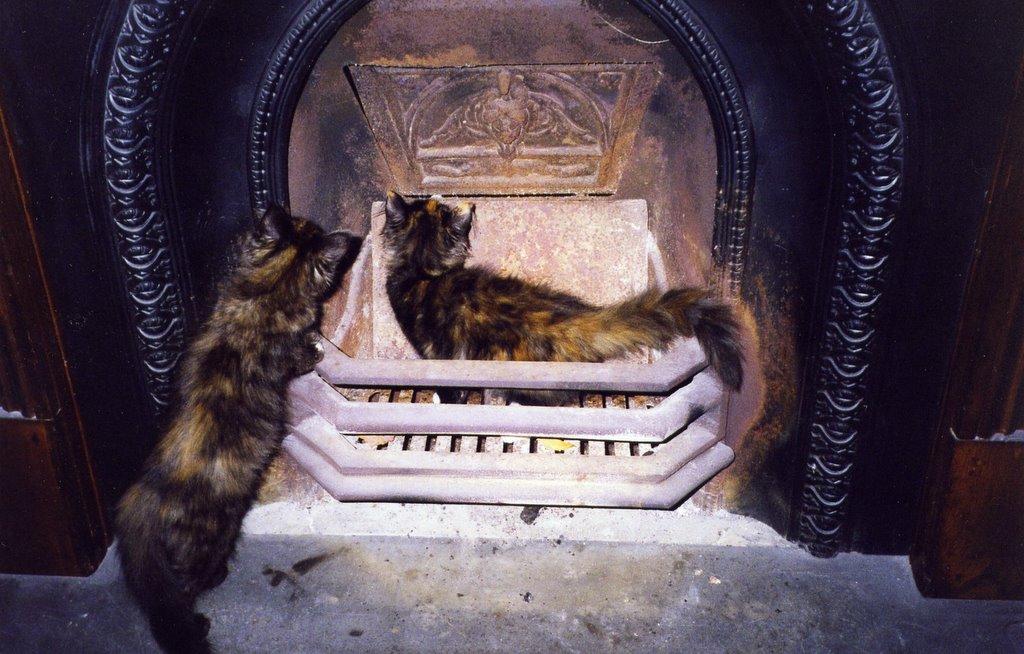
'Twas the night before Christmas ...
This pic is posted in support of Kate and Laura and their campaign to put the cred back in pet blogging. The 5% non-gratuitousness is of course the seasonal appropriateness of looking up the chimney.
It saddens me that a cat photo might be enough to make someone bugger off from one's blog in disgust and never look at it again, but what does that say about them? Does one really want ailurophobic or otherwise unimaginative readers? Personally I think of it as a form of triage.
Thursday, December 22, 2005
Weird habits meme
Well this is a new experience isn't it. I have been tagged by Elsewhere and must now follow these rules:
The first player of this game starts with the topic five weird habits of yourself, and people who get tagged need to write an entry about their five weird habits as well as state this rule clearly. In the end, you need to choose the next five people to be tagged and link to their web journals. Don't forget to leave a comment in their blog or journal that says You are tagged (assuming they take comments) and tell them to read yours.
The last bit will be the hardest, as I am only an apprentice blogger and nearly all of the people I would have the gall to tag have already done this one. (I'm guessing it's bad form to tag total strangers.)
But to the meme: FIVE WEIRD HABITS
1) When a book gets very exciting I will unconsciously mash and crease the corner of the page as I read, something I have done from a very early age. My mother, when she saw me doing this, would say in tones of deep sorrow 'Oh, poor book!' If this was intended to be an appeal to my better self, it didn't work.
2) I sing along in improvised but lame and uninspired harmonies while listening to great singers who would be much better off without my help.
3) I correct people who say infer when they mean imply, laying when they mean lying, disinterested when they mean uninterested, and 'I cannot help but think' when they mean either 'I cannot help thinking' or 'I cannot but think'. I persist in doing this even though I know it will make them hate me.
4) I will not travel anywhere further away from home than 100 km without wearing the St Christopher medal my folks gave me for Christmas 1987 and yes I know he's been debarred or unfrocked or whatever it is.
5) Nine times out of ten when I shop for clothes, I come home with something black, although I'm not a superannuated Goth or anything and don't do it deliberately. Black is slimming, it hides the dirt, it suits me, and it goes with everything: what's not to like?
Tagging: I'm a new girl in the blogosphere and am going to bail on the full tagging trip (will this get me expelled? Will I disappear in a puff of smoke? Will my scar hurt?) until I know a few more people. The only person I "know" even remotely well enough to tag, and who doesn't seem to have been tapped for this one so far, is ...
Kate!
The first player of this game starts with the topic five weird habits of yourself, and people who get tagged need to write an entry about their five weird habits as well as state this rule clearly. In the end, you need to choose the next five people to be tagged and link to their web journals. Don't forget to leave a comment in their blog or journal that says You are tagged (assuming they take comments) and tell them to read yours.
The last bit will be the hardest, as I am only an apprentice blogger and nearly all of the people I would have the gall to tag have already done this one. (I'm guessing it's bad form to tag total strangers.)
But to the meme: FIVE WEIRD HABITS
1) When a book gets very exciting I will unconsciously mash and crease the corner of the page as I read, something I have done from a very early age. My mother, when she saw me doing this, would say in tones of deep sorrow 'Oh, poor book!' If this was intended to be an appeal to my better self, it didn't work.
2) I sing along in improvised but lame and uninspired harmonies while listening to great singers who would be much better off without my help.
3) I correct people who say infer when they mean imply, laying when they mean lying, disinterested when they mean uninterested, and 'I cannot help but think' when they mean either 'I cannot help thinking' or 'I cannot but think'. I persist in doing this even though I know it will make them hate me.
4) I will not travel anywhere further away from home than 100 km without wearing the St Christopher medal my folks gave me for Christmas 1987 and yes I know he's been debarred or unfrocked or whatever it is.
5) Nine times out of ten when I shop for clothes, I come home with something black, although I'm not a superannuated Goth or anything and don't do it deliberately. Black is slimming, it hides the dirt, it suits me, and it goes with everything: what's not to like?
Tagging: I'm a new girl in the blogosphere and am going to bail on the full tagging trip (will this get me expelled? Will I disappear in a puff of smoke? Will my scar hurt?) until I know a few more people. The only person I "know" even remotely well enough to tag, and who doesn't seem to have been tapped for this one so far, is ...
Kate!
Wednesday, December 21, 2005
Consider the egg
In marble halls as white as milk,
Lined with a skin as soft as silk,
Within a fountain crystal clear,
A golden apple doth appear.
No doors there are to this stronghold,
Yet thieves break in and steal the gold.
Eggs are in the SA news this week. Big eastern-states producers are deliberately swamping the market with inferior and stale but incredibly cheap eggs at prices with which the local producers can't hope to compete. It's something to do with differing State regulations; nobody seems to be quite able to provide a clear explanation of what the problem is, but the local egg producers were out in force yesterday, showing their displeasure outside Parliament House and being, erm, egged on by Independent and parliamentary gadfly Nick 'No Pokies' Xenophon.
And today the Advertiser is running a shot of legendary local chef Cheong Liew holding a frypan with a fried egg in it in each hand. On the left we have the yucky, watery, tasteless, stale and badly shaped 'imported' Queensland egg, and on the right, the richly coloured, perfectly round and yummy-tasting local free-range product from down the freeway on the fertile and gorgeous Fleurieu Peninsula, home to some of the great wines of the world.
So today I went to quite a lot of trouble to make sure that the eggs for the mayo for the Christmas Day deluxe potato salad, and for the custard for the Christmas Day deluxe trifle, were local and fresh. (I wouldn't put it past my sisters to start agitating for devilled eggs as well, which means that by Boxing Day we'll have used up our cholesterol quota until Easter.) On either side of me in the supermarket, fellow punters were scanning the sides of the cartons for the same information.
The general consensus is that the eggs rolling in from the eastern states are crap and that most loyal South Australians are prepared to stump up quite a bit extra to support the local product, especially as it's manifestly fresher and better. But if free trade prevails and the SA producers end up going under, I'm going to have to take extreme measures and revert to my rural childhood. I've got a great big back yard and there is absolutely nothing to stop me (I know this because the bloke next door has chooks, so clearly the council doesn't mind) from clearing a patch of it, building a coop, and acquiring half a dozen little clucky ones of my own.
Tuesday, December 20, 2005
The examined life
From Susan Horsburgh's article on American artist Barbara Kruger, this year's winner of the Venice Biennale's lifetime achievement award, in today's Australian:
'In her works, Kruger aims to arouse uncertainty and knock her audience off balance. "That's to me what art can do, but that's what all commentary does to a certain degree," she says. "It's not about being political; it's just about really trying to live an examined life ... to ask questions about what it means to take another breath."'
Full text here.
'In her works, Kruger aims to arouse uncertainty and knock her audience off balance. "That's to me what art can do, but that's what all commentary does to a certain degree," she says. "It's not about being political; it's just about really trying to live an examined life ... to ask questions about what it means to take another breath."'
Full text here.
Monday, December 19, 2005
Putting the cat back in Magnificat
The 18th century English poet Christopher Smart, who lived only 49 years and spent four of those in an asylum, poor chap, is most famous for the epic poem he called his 'Magnificat': a series of verses, based on the antiphonal structure of Hebrew verses, that works as a sort of large-scale call-and-response and celebrates the creation of the world. The poem is called Jubilate Agno, 'Rejoice in the Lamb' (the Lamb being, of course, he who needs to be put back into Christmas, which is one reason for this post: I'm just doing my bit).
The other reason is that my stars yesterday said that I should express my appreciation and affection for my nearest and dearest, 'whether family, friends or little fur people with tails and whiskers'. And since the little fur people have been working overtime this week, draping themselves fetchingly about the furniture in artist's-model poses, cuddling up when I took to my bed with a virulent Christmas cold, standing guard on the night of the prowler, and, perhaps most astonishingly, not wrecking the Christmas tree, I thought I would post a tribute to them from the great Kit Smart, barking though he be. For the most famous part of Jubilate Agno is the passage about Smart's 'Cat Jeoffry':
For if he meets another cat he will kiss her in kindness.
For when he takes his prey he plays with it to give it a chance.
For one mouse in seven escapes by his dallying.
For when his day's work is done his business more properly begins.
For he keeps the Lord's watch in the night against the adversary.
For he counteracts the powers of darkness by his electrical skin and glaring eyes.
For he counteracts the Devil, who is death, by brisking about the life.
For in his morning orisons he loves the sun and the sun loves him.
For he is of the Tribe of Tiger.
For the Cherub Cat is a term of the Angel Tiger.
For he has the subtlety and hissing of a serpent, which in goodness he suppresses.
For he will not do destruction if he is well-fed, neither will he spit without provocation.
For he purrs in thankfulness when God tells him he's a good Cat.
For he is an instrument for the children to learn benevolence upon.
For every house is incomplete without him, and a blessing is lacking in the spirit ...
For there is nothing sweeter than his peace when at rest.
The other reason is that my stars yesterday said that I should express my appreciation and affection for my nearest and dearest, 'whether family, friends or little fur people with tails and whiskers'. And since the little fur people have been working overtime this week, draping themselves fetchingly about the furniture in artist's-model poses, cuddling up when I took to my bed with a virulent Christmas cold, standing guard on the night of the prowler, and, perhaps most astonishingly, not wrecking the Christmas tree, I thought I would post a tribute to them from the great Kit Smart, barking though he be. For the most famous part of Jubilate Agno is the passage about Smart's 'Cat Jeoffry':
For if he meets another cat he will kiss her in kindness.
For when he takes his prey he plays with it to give it a chance.
For one mouse in seven escapes by his dallying.
For when his day's work is done his business more properly begins.
For he keeps the Lord's watch in the night against the adversary.
For he counteracts the powers of darkness by his electrical skin and glaring eyes.
For he counteracts the Devil, who is death, by brisking about the life.
For in his morning orisons he loves the sun and the sun loves him.
For he is of the Tribe of Tiger.
For the Cherub Cat is a term of the Angel Tiger.
For he has the subtlety and hissing of a serpent, which in goodness he suppresses.
For he will not do destruction if he is well-fed, neither will he spit without provocation.
For he purrs in thankfulness when God tells him he's a good Cat.
For he is an instrument for the children to learn benevolence upon.
For every house is incomplete without him, and a blessing is lacking in the spirit ...
For there is nothing sweeter than his peace when at rest.
Sunday, December 18, 2005
Thinking of an angle

(Image from here.)
The leader of the country has chosen a weekend on which many Australians fear major race-based and religion-based violence to announce, with impeccable timing, that he wants to 'put Christ back into Christmas' (modest, too, the Rodent). His idea of how this should be done is for the department stores to bloat their already obscene profits further by selling nativity scenes.
He added in a neat, nay almost unnoticeable, twist that those who 'downplay' Christmas for fear of offending other religious groups are being 'intolerant'. Figure that one out.
Of course, this unspeakable piece of dog-whistling manipulativeness can no longer be named for what it is without getting had up for sedition.
I don't actually remember anyone taking the Christ out of Christmas. But it's a slow news season so the media does this beat-up every year and sometimes politicans jump on the bandwagon too if they think there's something there to milk. Like today, for example.
But look around you. There are more nativity scenes on sale than I've ever seen before. (Which is icky in itself, actually. Surely if what we are really concerned about is our spiritual well-being then it would be better for the soul -- believer or no believer -- to make one. Or better still, get your kids to make one.)
And it's not just nativity scenes. There are people belting out carols everywhere you turn; James Morrison, Casey Donovan, Wilbur Wilde and opera singer Ali McGregor teamed up for a blinder of a Little Drummer Boy tonight on, of all places, Spicks and Specks. What people are shopping for are the relics of the gifts brought by the Wise Men; every Christmas present is an allusion to the story. And most of all there are little kids doing the nativity thing, dressing up in teatowels, dropping the dolly, forgetting their lines, vomiting on each others' unsuspecting heads and making their mothers cry. That'll never go out of fashion.
And the only people I've seen complaining about any of it so far are a blond-haired, blue-eyed, hard-nosed family of resisters from NSW who say they're not Christians and they don't want their kids to have to go along with this stuff at what is supposed to be a secular State school. Oh, except for the endless moaning from people who are sick of shopping, cooking and cleaning, and/or are dreading spending a day with their families.
Personally I think those people who are downplaying Kwanzaa, Hanukkah and Hogmanay are being intolerant, too. I wonder what sorts of profits the department stores could turn there.
In the household of one friend this year, the large and beautiful nativity scene that has had pride of place on the hall table for several years now -- my friend is a complex creature, an ironist with a convent background and an eye for beauty -- has been arranged as usual, but there's one small twist. Everybody in the scene -- kings, goats, shepherds, lambs, right down to Joseph and Mary and the baby Jesus himself -- is gazing adoringly at the central object: her daughter's Dux of the School gold medal, propped up against a sheep.
Now that's really something to celebrate.
Friday, December 16, 2005
The story I'll never read
I've spent a big chunk of the last three or four days thinking and writing about, erm, thinking and writing, in comments exchanges on several different blogs. I thought about it some more this afternoon when re-reading (something I often do with favourite crime writers: it's comfort reading, perverse as that may seem) Kathy Reichs' Fatal Voyage.
Our heroine Tempe Brennan arrives back at the guesthouse near the plane crash site to discover that her room has been broken into and trashed:
'I went to the bathroom and splashed cold water on my face. Then I closed my eyes and played a childhood game I knew would calm me. Silently, I ran through the lyrics of the first song to come to mind. "Honky Tonk Woman".
The time-out with Mick and the Stones worked. Steadier, I returned and began gathering papers.'
What this reminded me of was another favourite book, Pawn in Frankincense, the fourth in Dorothy Dunnett's Lymond saga, in which the hero is unknowingly tricked by his treacherous household cook into becoming an opium addict. Near the end of the book, deeply addicted, he goes cold turkey and gets through the first two or three unspeakable days by reciting poetry to distract his mind and stop himself from screaming.
Yes, there's a pattern emerging here. Stories, songs and poetry will always help. In Ted Hughes's astonishing Birthday Letters of 1998 there is a wonderful poem called 'The Rag Rug', about sitting reading to his wife Sylvia Plath while she worked on her 'rich rag rug':
Whenever you worked at your carpet I felt happy.
Then I could read Conrad's novels to you.
I could cradle your freed mind in my voice,
Chapter by chapter, sentence by sentence,
Word by word: The Heart of Darkness,
The Secret Sharer. The same, I could feel
Your fingers caressing my reading, hour after hour,
Fitting together the serpent's jumbled rainbow.
Even the Sturm und Drang of that toxic, doomed relationship could be momentarily transformed by storytelling into the warm calm of a reciprocal caress, a balance of mind and body, a couple at rest. Conrad: another voice telling a different story, one that was not the violent story of their marriage, giving them time out from themselves.
But there's one story I know I will never read. Decades ago now, in a tutorial on Anna Karenina, the professor teaching the class advised us that if we ever found ourselves in despair, in our worst moment, in a true dark night of the soul, we should -- for consolation; medicinally, as it were -- read Tolstoy's novella The Death of Ivan Ilyich.
I haven't ever been able to bring myself to read it, and nor will I. Because to read it would be implicitly to claim that I had hit the bottom and that nothing worse was ever going to happen to me. And, hubris being what it is, something worse would immediately come along. Tolstoy's story, left unread, is a talisman protecting me from the worst that could happen.
Our heroine Tempe Brennan arrives back at the guesthouse near the plane crash site to discover that her room has been broken into and trashed:
'I went to the bathroom and splashed cold water on my face. Then I closed my eyes and played a childhood game I knew would calm me. Silently, I ran through the lyrics of the first song to come to mind. "Honky Tonk Woman".
The time-out with Mick and the Stones worked. Steadier, I returned and began gathering papers.'
What this reminded me of was another favourite book, Pawn in Frankincense, the fourth in Dorothy Dunnett's Lymond saga, in which the hero is unknowingly tricked by his treacherous household cook into becoming an opium addict. Near the end of the book, deeply addicted, he goes cold turkey and gets through the first two or three unspeakable days by reciting poetry to distract his mind and stop himself from screaming.
Yes, there's a pattern emerging here. Stories, songs and poetry will always help. In Ted Hughes's astonishing Birthday Letters of 1998 there is a wonderful poem called 'The Rag Rug', about sitting reading to his wife Sylvia Plath while she worked on her 'rich rag rug':
Whenever you worked at your carpet I felt happy.
Then I could read Conrad's novels to you.
I could cradle your freed mind in my voice,
Chapter by chapter, sentence by sentence,
Word by word: The Heart of Darkness,
The Secret Sharer. The same, I could feel
Your fingers caressing my reading, hour after hour,
Fitting together the serpent's jumbled rainbow.
Even the Sturm und Drang of that toxic, doomed relationship could be momentarily transformed by storytelling into the warm calm of a reciprocal caress, a balance of mind and body, a couple at rest. Conrad: another voice telling a different story, one that was not the violent story of their marriage, giving them time out from themselves.
But there's one story I know I will never read. Decades ago now, in a tutorial on Anna Karenina, the professor teaching the class advised us that if we ever found ourselves in despair, in our worst moment, in a true dark night of the soul, we should -- for consolation; medicinally, as it were -- read Tolstoy's novella The Death of Ivan Ilyich.
I haven't ever been able to bring myself to read it, and nor will I. Because to read it would be implicitly to claim that I had hit the bottom and that nothing worse was ever going to happen to me. And, hubris being what it is, something worse would immediately come along. Tolstoy's story, left unread, is a talisman protecting me from the worst that could happen.
Wednesday, December 14, 2005
If it's good enough for him ...
Longtime Fatwa victim Salman Rushdie on the realities and the virtues of multiculturalism:
"This is the question of our time: how does a fractured community of multiple cultures decide what values it must share in order to cohere, and how can it insist on those values even when they clash with some citizens’ traditions and beliefs?
The beginnings of an answer may be found by asking the question the other way around: what does a society owe to its citizens? The French riots demonstrate a stark truth. If people do not feel included in the national idea, their alienation will turn to rage."
Read the whole thing here.
"This is the question of our time: how does a fractured community of multiple cultures decide what values it must share in order to cohere, and how can it insist on those values even when they clash with some citizens’ traditions and beliefs?
The beginnings of an answer may be found by asking the question the other way around: what does a society owe to its citizens? The French riots demonstrate a stark truth. If people do not feel included in the national idea, their alienation will turn to rage."
Read the whole thing here.
How did s/he sleep?
From an item in yesterday's online New York Times describing the execution of gangster Tookie Williams:
"And at about 11:30 p.m. Monday, the governor rejected a second request for a 60-day reprieve, a legal appeal that prison officials said slightly delayed the start of the execution, originally scheduled for 12:01.
Among the 39 witnesses -- including journalists, victims’ relatives, Mr. Williams’s lawyers and supporters and prison officials -- several of the journalists who said they had witnessed other executions described the lethal injection procedure as unusually long, as a nurse struggled to insert a needle in Mr. Williams’s muscular left arm for about 12 minutes."
"And at about 11:30 p.m. Monday, the governor rejected a second request for a 60-day reprieve, a legal appeal that prison officials said slightly delayed the start of the execution, originally scheduled for 12:01.
Among the 39 witnesses -- including journalists, victims’ relatives, Mr. Williams’s lawyers and supporters and prison officials -- several of the journalists who said they had witnessed other executions described the lethal injection procedure as unusually long, as a nurse struggled to insert a needle in Mr. Williams’s muscular left arm for about 12 minutes."
Tuesday, December 13, 2005
Three things
1) Crikey.com.au announces in today's edition that next week it will be publishing the 2005 Crikey Honour Roll, comprising numerous awards for politics, business and media. Under 'Media' one of the awards will be for Best Blogger of the Year, which, no matter who gets it, will probably start a new round of Singing Bridges-type furore.
2) Also from crikey, here's a lovely note from Chris Graham, editor of National Indigenous Times, about the mob at Cronulla: 'As for the chant "We grew here, they flew here", the response going round Aboriginal Australia today is "We growed here, you rowed here."'
3) More great stuff on the Pakistan aid effort from Our Woman in Islamabad at Hotel Serena.
2) Also from crikey, here's a lovely note from Chris Graham, editor of National Indigenous Times, about the mob at Cronulla: 'As for the chant "We grew here, they flew here", the response going round Aboriginal Australia today is "We growed here, you rowed here."'
3) More great stuff on the Pakistan aid effort from Our Woman in Islamabad at Hotel Serena.
Monday, December 12, 2005
A practical demonstration of the Milne theory
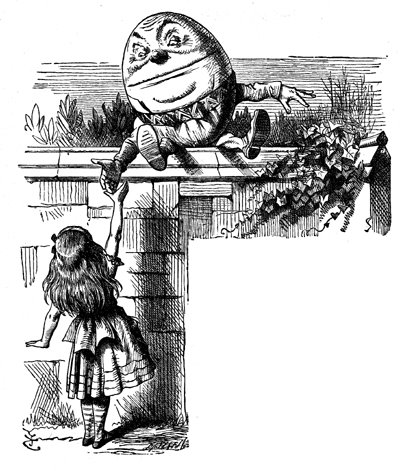
You've got to wonder whether John Howard had read Glenn Milne's column (see below) when he walked out to the microphone today and announced with a straight face that the Cronulla riots were not about racism. His eyelid didn't twitch or anything.
That's us told then.
Maybe he thinks the way to change the meaning of a word is to get it pushed through the Senate. Piece of cake. '"When I use a word," Humpty Dumpty said in rather a scornful tone, "it means just what I choose it to mean -- neither more nor less."
"The question is," said Alice,"whether you can make words mean different things."
"The question is," said Humpty Dumpty, "which is to be master -- that's all."'
Subscribe to:
Posts (Atom)