This afternoon the local ABC radio drive shift host was interviewing a 'rock historian' -- never heard of him myself -- about AC/DC. The bloke was responding in monosyllables and poor old Grant Cameron was audibly hanging onto his good humour, of which he has almost too much as a rule, when the conversation (such as it was) turned to AC/DC's name. Yairs. They got it off the back of a vacuum cleaner. Or possibly a sewing-machine.
(With hindsight, this was the most interesting bit of the conversation. What were the feral AC/DC boys doing in the vicinity of such very girlie home-making appliances?)
Cameron enquired delicately whether the band's name might not also have possibly been some indirect allusion to the possible bisexuality of one or two of the band members?
The interviewee audibly woke up. 'Naaaaoooouwwwhhhh,' he said, his voice freighted with scorn. 'Look. Every one of those boys was hard-working, and straightforward, and they all knew what they wanted and went after it. So nooaahhh, nothing like that.'
So there you have it. Bisexuality equates (presumably) with laziness, evasiveness and lack of focus. God knows what he would have said about somebody who was actually full-on one-way gay or lesbian. Dyslexic? Bad cooks? Kitten murderers?
Next time I'm whining about the bad press that straight independent middle-aged women with no children get, I'll think back to this moment and shut mah mouth.
Tuesday, October 31, 2006


Monday, October 30, 2006
Adelaide's Audreys at the ARIAs
 Pic from here, plus a lot of other good stuff
Here's something I wrote in a local-tourism column about pubs around Adelaide back in December 2004 when The Audreys were still a well-kept secret:
'By mid-afternoon, as a leisurely birthday lunch at the Stanley Bridge Tavern in Verdun reaches the post-coffee stage and we are now the only group left in the dining room, a slender young woman with short dark hair and an equally young man in a very cool hat come through the door lugging a cargo of amplifiers and instruments. They turn out to be Taasha Coates and Tristan Goodall, one half of The Audreys, and by the time they’ve set up for their pre-gig sound check and sung a few bars of this and that, it’s clear that they are very, very good. Taasha and Tristan are now Thursday night regulars there, playing audience-interactive acoustic sets that show off their lyrical, disciplined musicality, their collection of neo-folkie ‘toy-store instrumentation’, and their extensive repertoire up at the folksy end of rock, the classy end of country and the bluesy end of, well, blues.'
Sure enough, last night The Audreys won an ARIA for Best Blues and Roots Album. Am I a deadly talent-spotter or what? The album is Between Last Night and Us, and here's a taste, from Track 4, Pale Dress.
A colony of whatever they are
And in keeping with the elevated tone of that last post, here's a word from the ever-classy Senator Heffernan, a man with good sensible views on biodiversity: platypus schlatypus, kill them all!
The public has a right to know

I see Derryn Hinch has been suffering from unspecified health problems that have cause him to have a near-death experience he apparently couldn't resist using for self-publicity. But he ain't sayin' what caused it.
Given how much too much information we already have about Derryn's inner workings thanks to the horrid All-Bran ads, I can only assume that there's something wrong with his gut which if disclosed would give rise to cruel jokes about the product he endorses.
But hey, the public has a right to know. Cue loudmouthed shock jock burrowing through unsavoury sources. A little sauce for the gander.
Sunday, October 29, 2006
Further thoughts on Werribee
I remember Werribee. In 1980 and 1981, before I learned to drive, I caught the train between Melbourne and Geelong a lot. Going through Werribee (as through any town) on a train was instructive, at once depressing and intriguing. Backyards tell you a lot. Houses backing onto the railway line tell you more.
My guess is that none of the Werribee gang grew up near the railway line; this story seems more akin to the one that came out of Sydney a few years ago about private schoolboys forcibly sodomising each other with large wooden objects. But the 'wrong side of the tapestry' effect of what you see when you ride on a train through a town is sticking in my mind.
Barista has posted a link to, and some thoughts on, the Today Tonight follow-up segment on which, at the request of the victim's father, some edited grabs from the notorious DVD were screened. If your stomach can stand it, it is quite instructive. Check out the POV: who has the camera? Isn't there some uncertainty there, a kind of hesitation about the gap between events as planned and events as they unfold? What does he choose to focus on?
Then there's the sequence of events. Nobody in it seems to quite know how this story is supposed to go. One of the perpetrators even comments on this fact. Nobody knows where they are supposed to be looking. 'The Victim' is clearly not the focus of their attention. The focus of their attention, insofar as they have one, seems to be the camera.
While I watched this weird anti-spectacle, I felt two things, both seen many years ago and long forgotten, scratching at the back of my mind. One was a wildlife doco about hyenas: approach in packs, circle, hang back, rush in and snatch or snarl and then back off again. The other was Peter Brook's 1963 movie of Lord of the Flies.
I remembered a story our English teacher told us about the filming of this movie. You could see her wondering, while she was telling us, whether she ought to be doing so. Apparently the perfectly nice stitched-up 1960s middle-class schoolboy cast went increasingly feral as the filming progressed. One night one of the on-location adults went to investigate a commotion in one of the bedrooms and found the boys chucking freshly-caught lizards into the blades of a full-speed electric fan.
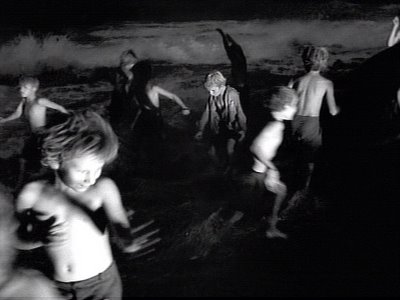 Still from Lord of the Flies, 1963
My guess is that none of the Werribee gang grew up near the railway line; this story seems more akin to the one that came out of Sydney a few years ago about private schoolboys forcibly sodomising each other with large wooden objects. But the 'wrong side of the tapestry' effect of what you see when you ride on a train through a town is sticking in my mind.
Barista has posted a link to, and some thoughts on, the Today Tonight follow-up segment on which, at the request of the victim's father, some edited grabs from the notorious DVD were screened. If your stomach can stand it, it is quite instructive. Check out the POV: who has the camera? Isn't there some uncertainty there, a kind of hesitation about the gap between events as planned and events as they unfold? What does he choose to focus on?
Then there's the sequence of events. Nobody in it seems to quite know how this story is supposed to go. One of the perpetrators even comments on this fact. Nobody knows where they are supposed to be looking. 'The Victim' is clearly not the focus of their attention. The focus of their attention, insofar as they have one, seems to be the camera.
While I watched this weird anti-spectacle, I felt two things, both seen many years ago and long forgotten, scratching at the back of my mind. One was a wildlife doco about hyenas: approach in packs, circle, hang back, rush in and snatch or snarl and then back off again. The other was Peter Brook's 1963 movie of Lord of the Flies.
I remembered a story our English teacher told us about the filming of this movie. You could see her wondering, while she was telling us, whether she ought to be doing so. Apparently the perfectly nice stitched-up 1960s middle-class schoolboy cast went increasingly feral as the filming progressed. One night one of the on-location adults went to investigate a commotion in one of the bedrooms and found the boys chucking freshly-caught lizards into the blades of a full-speed electric fan.
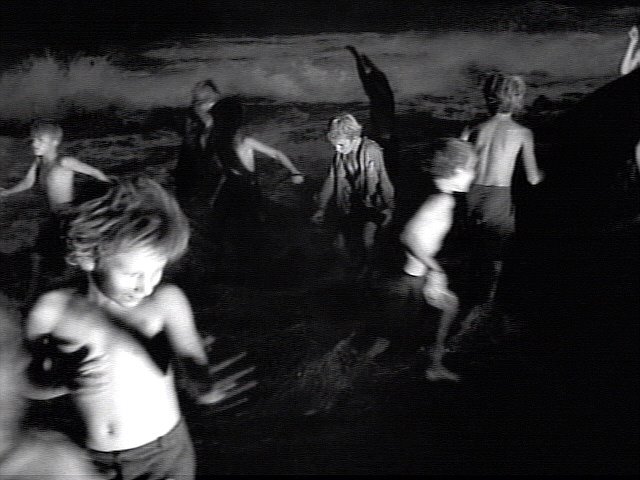 Still from Lord of the Flies, 1963
Saturday, October 28, 2006
Mrs Tiggy-Winkle rides again
In a desperate last-ditch effort to turn into some kind of tidy person in my later years, and if you could see the kitchen or indeed any other room in this house you would know just how Herculean a task we're talking about here, I have started a collection of housewifely mantras of tidiness, which I should like to share.
'I don't like to have one day spill over into the next' -- my mum, on why she wouldn't go to bed if there was anything at all left in or on the kitchen sink.
'Every time I bring something new into the house, I get rid of something old' -- my friend L. I can see how this one might stop the hallway from filling up with books and forcing me to start getting into and out of the house through the roof.
'If you don't make a mess, you won't have a mess to clean up' -- L's mum. Easy for her to say, I'm sure.
'Never walk from one room to another with empty hands' -- my friend D. This is a beauty. The house is much tidier since I heard her say this.
'Clear as you go' -- Mrs Beeton.
'Put the cats' meat in the fridge' -- You-Know-Who.

'I don't like to have one day spill over into the next' -- my mum, on why she wouldn't go to bed if there was anything at all left in or on the kitchen sink.
'Every time I bring something new into the house, I get rid of something old' -- my friend L. I can see how this one might stop the hallway from filling up with books and forcing me to start getting into and out of the house through the roof.
'If you don't make a mess, you won't have a mess to clean up' -- L's mum. Easy for her to say, I'm sure.
'Never walk from one room to another with empty hands' -- my friend D. This is a beauty. The house is much tidier since I heard her say this.
'Clear as you go' -- Mrs Beeton.
'Put the cats' meat in the fridge' -- You-Know-Who.
Friday, October 27, 2006
Creative Writing 101: and now a word from the cats' meat
From today's online Australian:
Edited transcript of Sheik Hilali's speech
This is an edited transcript, by SBS translator Dalia Mattar, of Sheik Taj Din al-Hilali's speech
October 27, 2006
" ... when it comes to adultery, it's 90 per cent the women's responsibility. Why? Because a woman possesses the weapon of seduction. It is she who takes off her clothes, shortens them, flirts, puts on make-up and powder and takes to the streets, God protect us, dallying. It's she who shortens, raises and lowers. Then it's a look, then a smile, then a conversation, a greeting, then a conversation, then a date, then a meeting, then a crime, then Long Bay jail. ...
"But when it comes to this disaster, who started it? In his literature, scholar al-Rafihi says: 'If I came across a rape crime – kidnap and violation of honour – I would discipline the man and order that the woman be arrested and jailed for life.' Why would you do this, Rafihi? He says because if she had not left the meat uncovered, the cat wouldn't have snatched it."
"If you take a kilo of meat, and you don't put it in the fridge or in the pot or in the kitchen but you leave it on a plate in the backyard, and then you have a fight with the neighbour because his cats eat the meat, you're crazy. Isn't this true?
"If you take uncovered meat and put it on the street, on the pavement, in a garden, in a park or in the backyard, without a cover and the cats eat it, is it the fault of the cat or the uncovered meat? The uncovered meat is the problem.
"If the meat was covered, the cats wouldn't roam around it. If the meat is inside the fridge, they won't get it.
"If the meat was in the fridge and it (the cat) smelled it, it can bang its head as much as it wants, but it's no use.
"If the woman is in her boudoir, in her house and if she's wearing the veil and if she shows modesty, disasters don't happen.
From The New Princeton Encyclopedia of Poetry and Poetics (eds Preminger and Brogan, 1993):
'The most revered form of simile is the epic simile, a lengthy comparison between two highly complex objects, actions or relations.'
The epic simile is a bloody hard thing for a writer to sustain successfully because every element of it has to make sense. It's like a sort of fable or short allegory -- think Animal Farm where every creature and action and all the relationships among them are standing in for the 'real' situation. Each substition or comparison -- Snowball=Trotsky, sheep=Teh Masses, farm=Russia etc etc -- has to fit logically with all the others, if you want to create a coherent narrative and second tier of meaning.
Never mind, for the moment, Sheik Hilali's demented world view; let's have a look at his speechwriting abilities. For a start it's not even an original image; he's paraphrasing al-Rahifi. But has he chosen well here? Is it a good, successful, rhetorically effective figure of speech?
If the women are the meat, then all those sexually incontinent men must be the cats, right?
So here's what I want to know. If the women are the meat and the men are the cats, then who are these cat-owners and neighbours? Is there some sinister extra dimension to this little fairytale that I'm not picking up? Or is it just incoherent as well as repulsive?
 Be afraid. Be very afraid.
Edited transcript of Sheik Hilali's speech
This is an edited transcript, by SBS translator Dalia Mattar, of Sheik Taj Din al-Hilali's speech
October 27, 2006
" ... when it comes to adultery, it's 90 per cent the women's responsibility. Why? Because a woman possesses the weapon of seduction. It is she who takes off her clothes, shortens them, flirts, puts on make-up and powder and takes to the streets, God protect us, dallying. It's she who shortens, raises and lowers. Then it's a look, then a smile, then a conversation, a greeting, then a conversation, then a date, then a meeting, then a crime, then Long Bay jail. ...
"But when it comes to this disaster, who started it? In his literature, scholar al-Rafihi says: 'If I came across a rape crime – kidnap and violation of honour – I would discipline the man and order that the woman be arrested and jailed for life.' Why would you do this, Rafihi? He says because if she had not left the meat uncovered, the cat wouldn't have snatched it."
"If you take a kilo of meat, and you don't put it in the fridge or in the pot or in the kitchen but you leave it on a plate in the backyard, and then you have a fight with the neighbour because his cats eat the meat, you're crazy. Isn't this true?
"If you take uncovered meat and put it on the street, on the pavement, in a garden, in a park or in the backyard, without a cover and the cats eat it, is it the fault of the cat or the uncovered meat? The uncovered meat is the problem.
"If the meat was covered, the cats wouldn't roam around it. If the meat is inside the fridge, they won't get it.
"If the meat was in the fridge and it (the cat) smelled it, it can bang its head as much as it wants, but it's no use.
"If the woman is in her boudoir, in her house and if she's wearing the veil and if she shows modesty, disasters don't happen.
From The New Princeton Encyclopedia of Poetry and Poetics (eds Preminger and Brogan, 1993):
'The most revered form of simile is the epic simile, a lengthy comparison between two highly complex objects, actions or relations.'
The epic simile is a bloody hard thing for a writer to sustain successfully because every element of it has to make sense. It's like a sort of fable or short allegory -- think Animal Farm where every creature and action and all the relationships among them are standing in for the 'real' situation. Each substition or comparison -- Snowball=Trotsky, sheep=Teh Masses, farm=Russia etc etc -- has to fit logically with all the others, if you want to create a coherent narrative and second tier of meaning.
Never mind, for the moment, Sheik Hilali's demented world view; let's have a look at his speechwriting abilities. For a start it's not even an original image; he's paraphrasing al-Rahifi. But has he chosen well here? Is it a good, successful, rhetorically effective figure of speech?
If the women are the meat, then all those sexually incontinent men must be the cats, right?
So here's what I want to know. If the women are the meat and the men are the cats, then who are these cat-owners and neighbours? Is there some sinister extra dimension to this little fairytale that I'm not picking up? Or is it just incoherent as well as repulsive?
 Be afraid. Be very afraid.
Something warm to put your feet on in the morning
From a comment thread at the SMH blog All Men are Liars:
'Most of my girlfriends, like me, like a bit of the chase ourselves. Guys that run around you doe-eyed and sleep beside your bed so you have something warm to put your feet on in the morning (ok i am exaggerating here) are a complete turn off.'
Oh, I don't know. I could struggle along with one of those.
'Most of my girlfriends, like me, like a bit of the chase ourselves. Guys that run around you doe-eyed and sleep beside your bed so you have something warm to put your feet on in the morning (ok i am exaggerating here) are a complete turn off.'
Oh, I don't know. I could struggle along with one of those.
Thursday, October 26, 2006
Guardian of the garden
I lived in Victoria for almost twenty years, and whenever I drove over to Adelaide to see my family, my mother and I would take a ceremonial walk around her big garden and she'd give me a running commentary on how everything was going: what was doing well and what badly, what was blossoming, what had new shoots, what needed dead-heading or de-bugging.
Whenever something in the garden died, she took it as a personal affront. Her particular euphemism for 'died', as applied to the garden, was turned up its toes. (None of this 'RIP Phlox, fell asleep 25/12/06' type molly-pandering for my Ma, although she did occasionally also say that some hapless bit of vegetation had gone to God.)
Readers lucky enough still to have both parents and not to be estranged from either will not yet be aware that you go on talking to them after they die, and that the line between the dead and the living is nowhere near as clear as you think. So this morning it didn't seem at all strange to be reporting to my mum, wherever she is, that the self-sown oregano growing up through a crack in the path has for some unknown reason, and overnight, turned up its toes and gone to God.
As I formulated this thought I heard her voice as clear as day. Well, hurry up and take a couple of cuttings and pot them before it's too late.
Whenever something in the garden died, she took it as a personal affront. Her particular euphemism for 'died', as applied to the garden, was turned up its toes. (None of this 'RIP Phlox, fell asleep 25/12/06' type molly-pandering for my Ma, although she did occasionally also say that some hapless bit of vegetation had gone to God.)
Readers lucky enough still to have both parents and not to be estranged from either will not yet be aware that you go on talking to them after they die, and that the line between the dead and the living is nowhere near as clear as you think. So this morning it didn't seem at all strange to be reporting to my mum, wherever she is, that the self-sown oregano growing up through a crack in the path has for some unknown reason, and overnight, turned up its toes and gone to God.
As I formulated this thought I heard her voice as clear as day. Well, hurry up and take a couple of cuttings and pot them before it's too late.
Tuesday, October 24, 2006
I don't believe in evil ...
.. but that resistance gets tested anew, and more violently, every day.
My friend D would argue that these boys are like this because they have disadvantaged backgrounds / bad parenting / not fully responsible for their actions / failure of society to nurture them properly / etc etc.
And I am usually prepared to go a fair way with her on this (though we haven't discussed the Dianne Brimble case, and if we did it might shake the old friendship tree a little too hard for comfort) -- partly because this bit of evidence from the linked article so strongly supports her view: 'parents of the boys who produced the DVD laughed it off as "just a bit of fun".'
Subcultural, familial and peer-group ignorance and cruelty are behind a lot of unspeakable behaviour; look at the Brimble gang, or the Ocean Grove footy team officials who were so bewildered that anyone might think the team members' hurling of drunken anti-Semitic verbal and physical abuse from a bus at a pedestrian and his children might be regarded as a bad thing. Strikes me there are close similarities in all three cases -- and that the common element is a group of not-very-bright young males. Der.
But when it comes to pissing on a girl with a 'slight developmental delay', sexually abusing her, setting her on fire, and making a DVD of it -- nope. I don't give a rat's arse how they got like that. Sorry.
And there is, of course, no excuse for Channel Seven at all.
My friend D would argue that these boys are like this because they have disadvantaged backgrounds / bad parenting / not fully responsible for their actions / failure of society to nurture them properly / etc etc.
And I am usually prepared to go a fair way with her on this (though we haven't discussed the Dianne Brimble case, and if we did it might shake the old friendship tree a little too hard for comfort) -- partly because this bit of evidence from the linked article so strongly supports her view: 'parents of the boys who produced the DVD laughed it off as "just a bit of fun".'
Subcultural, familial and peer-group ignorance and cruelty are behind a lot of unspeakable behaviour; look at the Brimble gang, or the Ocean Grove footy team officials who were so bewildered that anyone might think the team members' hurling of drunken anti-Semitic verbal and physical abuse from a bus at a pedestrian and his children might be regarded as a bad thing. Strikes me there are close similarities in all three cases -- and that the common element is a group of not-very-bright young males. Der.
But when it comes to pissing on a girl with a 'slight developmental delay', sexually abusing her, setting her on fire, and making a DVD of it -- nope. I don't give a rat's arse how they got like that. Sorry.
And there is, of course, no excuse for Channel Seven at all.
Getting better
What is it about a brush with mortality and a few days of submergence in the weird underworld of hospitals, doctors and industrial-strength drugs that brings out the very best in bloggers? First there was this classic Barista post, and now my friend Stephanie, in much the same newly-convalescent condition, reflects over at Humanities Researcher on her own experiences.
I remember from my academic days someone giving a research seminar on pathographies -- 'narratives of illness and cure'. Maybe one reason such writing tends to the dramatically good is that narrative and illness have similar trajectories: up or down, depending on genre, and punctuated by what the writing dudes call plot points, the moments of crisis where things will turn one way or the other. The very nature of the experience gives the writing a natural shape.
Maybe blogging is a particularly good mode for such experience; bloggers can write it and readers can read it almost in real time, recording and following the trajectory of the experience as it happens, and very likely even in an interactive way -- so that the act of blogging itself is therapeutic, and the responses from concerned and attentive readers maybe even more so.
I remember from my academic days someone giving a research seminar on pathographies -- 'narratives of illness and cure'. Maybe one reason such writing tends to the dramatically good is that narrative and illness have similar trajectories: up or down, depending on genre, and punctuated by what the writing dudes call plot points, the moments of crisis where things will turn one way or the other. The very nature of the experience gives the writing a natural shape.
Maybe blogging is a particularly good mode for such experience; bloggers can write it and readers can read it almost in real time, recording and following the trajectory of the experience as it happens, and very likely even in an interactive way -- so that the act of blogging itself is therapeutic, and the responses from concerned and attentive readers maybe even more so.
Saturday, October 21, 2006
Brilliant creatures
It's a very good thing that SBS is currently screening reruns of RocKwiz, because otherwise, not having seen it the first time, I would tonight have missed the always brilliant and gorgeous Deborah Conway singing that wonderful duet on Love Hurts with Tex Perkins, who was looking (the three-day growth may have been partly responsible for this) like an older, funnier and way badder Australian Viggo Mortensen.
Phwooaar.

Phwooaar.

Friday, October 20, 2006
I say potahto

I note, with icy disdain, that the word 'ass' to mean 'backside' is becoming common in Australian usage.
IT'S AN ARSE, PEOPLE.
Always has been, always will be.
Surely the spread of 'ass' (so to speak) is just one more indication that under this government we have become little more than a pathetic puppet of the US. Does this freeze anyone else's blood, or is it just me?
Two brilliant things about marriage, from two new(ish) books
*****
I was enjoying this morning until now. 'Not before breakfast,' I say. I do not add, 'You know I can't handle it this early in the day.' I've added that before; it's only had an intermittent effect. After this long together, both of our heads are filled with such minor admonitions, helpful hints about the other person -- likes and dislikes, preferences and taboos. Don't come up behind me like that when I'm reading. Don't use my kitchen knives. Don't just strew things. Each believes the other should respect this frequently reiterated set of how-to instructions, but they cancel each other out: if Tig must respect my need to wallow mindlessly, free of bad news, before the first cup of coffee, shouldn't I respect his need to spew out catastrophe so he himself will be rid of it?
'Oh. Sorry,' he says. He shoots me a reproachful look.
*****
-- Margaret Atwood, Moral Disorder
*****
Julia believed no outing was worth its while unless it ended up with tea and cake. He knew everything Julia believed. He could have gone on one of those Mr and Mrs quizzes and answered eveything about her likes and dislikes. He wondered if she would be able to do the same for him ...
For Jackson, words were functional, they helped you get to places and to explain things. For Julia they were freighted with inexplicable emotion.
'Afternoon tea' itself, of course, was one of Julia's all-time favourite phrases ('Good enough words on their own, but together perfect'). Afternoon tea usually trailed a few excessive adjectives in its wake -- 'scrumptious', 'yummy', 'heavenly'.
'Warm Bakery Basket' was another of her favourites, as were (mysteriously) 'autumn equinox' and 'lamp black'. Certain words, she said, made her toes 'positively curl with happiness' -- 'rum', 'vulgar', 'blanchisserie', 'hazard', 'perfidious', 'treasure', 'divertimenti'. Certain scraps and lines of poetry -- Of his bones are coral made and They flee from me that sometime did me seek sent her into sentimental rapture. The 'Hallelujah Chorus' made her sob, as did Lassie Come Home (the whole film, title to closing credits). Jackson sighed. Jackson Brodie, the all-time winner of Mr and Mrs.
*****
-- Kate Atkinson, One Good Turn
I was enjoying this morning until now. 'Not before breakfast,' I say. I do not add, 'You know I can't handle it this early in the day.' I've added that before; it's only had an intermittent effect. After this long together, both of our heads are filled with such minor admonitions, helpful hints about the other person -- likes and dislikes, preferences and taboos. Don't come up behind me like that when I'm reading. Don't use my kitchen knives. Don't just strew things. Each believes the other should respect this frequently reiterated set of how-to instructions, but they cancel each other out: if Tig must respect my need to wallow mindlessly, free of bad news, before the first cup of coffee, shouldn't I respect his need to spew out catastrophe so he himself will be rid of it?
'Oh. Sorry,' he says. He shoots me a reproachful look.
*****
-- Margaret Atwood, Moral Disorder
*****
Julia believed no outing was worth its while unless it ended up with tea and cake. He knew everything Julia believed. He could have gone on one of those Mr and Mrs quizzes and answered eveything about her likes and dislikes. He wondered if she would be able to do the same for him ...
For Jackson, words were functional, they helped you get to places and to explain things. For Julia they were freighted with inexplicable emotion.
'Afternoon tea' itself, of course, was one of Julia's all-time favourite phrases ('Good enough words on their own, but together perfect'). Afternoon tea usually trailed a few excessive adjectives in its wake -- 'scrumptious', 'yummy', 'heavenly'.
'Warm Bakery Basket' was another of her favourites, as were (mysteriously) 'autumn equinox' and 'lamp black'. Certain words, she said, made her toes 'positively curl with happiness' -- 'rum', 'vulgar', 'blanchisserie', 'hazard', 'perfidious', 'treasure', 'divertimenti'. Certain scraps and lines of poetry -- Of his bones are coral made and They flee from me that sometime did me seek sent her into sentimental rapture. The 'Hallelujah Chorus' made her sob, as did Lassie Come Home (the whole film, title to closing credits). Jackson sighed. Jackson Brodie, the all-time winner of Mr and Mrs.
*****
-- Kate Atkinson, One Good Turn
Tuesday, October 17, 2006
One way of looking at three blackbirds*
I happened to glance up through the kitchen window a while ago as I was assembling toast and coffee, and saw three blackbirds perched in a row along the fence a few feet away. One had its back to me and as it moved the direct sunlight hit its shoulders, which turned a shimmery glossy blue, green, purple and silver.
Three blackbirds in a group is something you don't see much. Also, they usually notice any movement at the kitchen sink and fly away. Today they all just went on teetering there. One had its bright-yellow beak open, also a bit odd. Then I realised the one with the open beak was visibly smaller and fluffier than the other two.
Flying lesson. Must be Spring.
* If you find this title cryptic, go here.
Three blackbirds in a group is something you don't see much. Also, they usually notice any movement at the kitchen sink and fly away. Today they all just went on teetering there. One had its bright-yellow beak open, also a bit odd. Then I realised the one with the open beak was visibly smaller and fluffier than the other two.
Flying lesson. Must be Spring.
* If you find this title cryptic, go here.
Subscribe to:
Posts (Atom)